Chris Anderson. Sarasota Herald-Tribune
View Comments
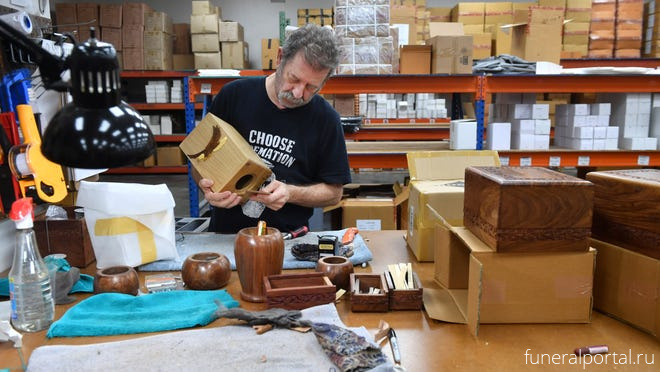
There is a reason Andrea Bogard LeBlanc smiles a lot. The business of death is good. Fun, too. Some of her employees even wear shirts that read: “Choose cremation. You’ve urned it.”
Of course, this is not to say it’s all squirting lapels and animal balloons at Bogati Urn Company in Sarasota, one of the largest businesses of its kind in the United States. It is a wholesale vehicle for funeral homes across the nation and offers urns and memorial jewelry for both human and pet remains.
It’s a ruthless business, Bogard LeBlanc said, and success must be “urned,” which she didn’t say, but the numbers speak for themselves. Largely because COVID caused the death rate to skyrocket, the company took in $4.2 million in 2020, up from $2.5 million the year before.

The company’s 14,400 square-foot building had to go. Too small. So last Labor Day Bogati Urn Company moved into a 30,800 square-foot building in north Sarasota with wood floors throughout, office spaces, product showcases, a jewelry room, a packaging room, loading docks for the daily UPS run, and a bed for Lily the beagle mix to take naps in.
“It’s been really fun growing this business,” Bogard LeBlanc said. “And a lot of hard work.”
From people who design the website to those packaging the urns and shipping them, Bogard LeBlanc employs a staff of 16.
“I had to find the right people,” she said. “Let’s face it, there is a creep-out factor.”
Because Bogard LeBlanc always plans for growth, she had enough product in stock during COVID to sustain the export stoppages from places like China and India, where wood, brass and alloy urns are shipped from.
The company has many types of urns, including ones adorned with mother of pearl, the glowing material found inside oysters and marine snails, and Bogard LeBlanc actually needs a license from the Florida Fish and Wildlife Conservation Commission to deal them, because those types of shells are considered living things.

The company has urns for veterans, urns with an artistic flair, even football urns. Though they don’t project the name of the school on them, there are urns with gators, Seminoles and bulldogs on them. Actually, they don’t have Seminole urns anymore. They weren’t selling. For FSU alumni and fans, that’s good. Isn’t it?
They even have urns with dents in them, because, well, let’s be honest here, life isn’t always perfect, is it?
They have 300 different pieces of memorial jewelry and sell 4,000 pieces a month. All are neatly contained, marked and packaged in the special jewelry room. They sell boxes of a dozen to funeral homes, which will arrange them in a room for grieving family members to see without being pressured to buy.

They sell jewelry pendants with compartments for ashes. Things like hearts, bullets, keys, ladybugs, tires (for car enthusiasts), footballs, frogs, sandals, guitars, and 8-balls (the pool kind). All of it is cheerful and bright.
That’s because “we’re celebrating,” Bogard LeBlanc said.
Dragonflies, butterflies and red cardinals are popular. They are symbols of death. Purple is viewed as a color of death, but also of royalty.
Bogard, as upbeat as she is, treats the nature of the business with respect, and every so often the fragility of life hits home in an emotional way. In particular, she remembers the mother of a 23-year-old murder victim who once requested an urn that matched the color of her late daughter’s prom dress. That made her cry.
“Even though that was awful, we really helped that family,” she said.

Bogard LeBlanc is pleased her company is able to help grieving families as well as the funeral home industry she respects. She even awards a scholarship each year to a student who wants to go into the mortuary science field. You have to apply with a letter and it has to be personal. She reads each one.
And now for some cremation fun facts, according to Bogard LeBlanc:
One pound of healthy weight when a person is alive is equal to one cubic inch of cremated remains when they are not; the matter from animal bones is darker than from human bones for some reason; and before a person is cremated, things like artificial hips and pacemakers are removed.
Do you know what happens to them? They are recycled. That’s right, grandpa’s artificial knee may have been your other grandpa’s artificial knee. It’s a big business, she said. Bullets must be removed from bodies as well, or they could explode during the process.
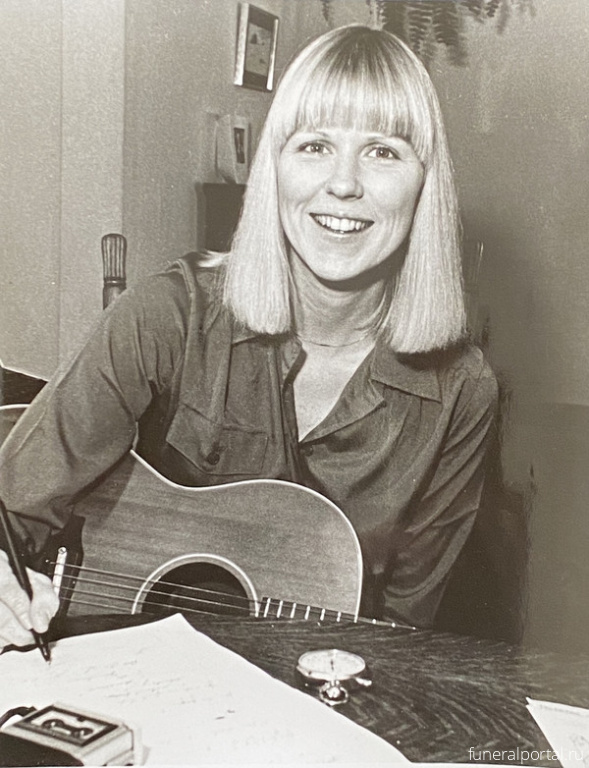
Bogard LeBlanc sold newspaper advertising in California and Texas in the 1990s before returning to school to become a nurse, working first at Sarasota Memorial Hospital, then for a private company. She eventually bought and ran a six-unit rehabilitation facility, but grew weary and frustrated from it. She knew it was up to her to change what made her unhappy, something she learned from the suicide death of her mother, and so she did.

She was married to a man who imported things such as jars, and that’s what sparked the urn idea she invested $1,800 in. She began by taking her products to funeral trade shows and working off eBay. Soon she had a distributor.
Now, she has a business that took in over $4 million in 2020. And considering 2.5 million people die each year on average, with COVID raising that rate by over 400,000, not to mention the fact there are roughly 19,000 funeral homes in the U.S., more growth is expected for Bogati Urn Company.
“A combination of creativity and death” is how she describes her business.
“And it’s really fun.”