Originally part of the 1960s psychedelic scene, Rhodes pioneered upbeat powerpop and inspired generations with his home recordings
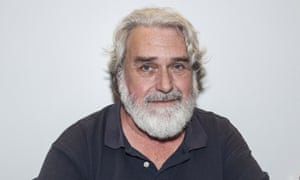
Emitt Rhodes in 2016. Photograph: Timothy Norris/Getty Images
Emitt Rhodes, the cult US musician who helped shape the powerpop genre, has died aged 70.
His death was confirmed by Tony Blass, who produced a 2009 documentary about Rhodes, The One Man Beatles. Blass said he was “honoured and blessed to have worked and spent time with him”.
Rhodes was born in Decatur, Illinois in 1950, and grew up in Los Angeles. He played drums with garage rockers the Palace Guard, immortalised on the scene-encapsulating Nuggets compilation with their song Falling Sugar.
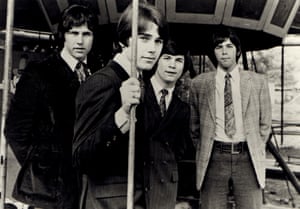
The Merry-Go-Round, circa 1967. Photograph: GAB Archive/Redferns
Still aged only 16, he then fronted psych-pop band the Merry-Go-Round. They had a hit with the song Live, which chimed with the free spirits of the hippy era, but the band only released one album and broke up in 1969.
Rhodes went solo and built a home studio in his parents’ garage, where he wrote, performed and produced three albums almost entirely on his own. “I was a drummer and I had a piano and I had a guitar and I just started there,” he said in 2001. “The next thing I knew I wanted to play the violin and the sax and the flute and the harmonica and the banjo and everything. I’m a tinkerer. I would buy an instrument and an instructional book, and just play scales for an hour a day until I felt comfortable doing it.”
His first, self-titled album was a success, reaching No 29 in the US charts (Wes Anderson later used its song Lullabye in his film The Royal Tenenbaums). His melodic style has often been compared to Paul McCartney’s, and as well as helping to forge the positivist powerpop genre that flourished in the late 1970s, his home-recording approach was influential on generations of independent and lo-fi musicians.
He took an extended break from recording after legal disputes with his record label, instead producing other artists’ work until 2016, when he recorded another solo album, Rainbow Ends. It featured guest appearances from musicians who admired him including Aimee Mann, Richard Thompson, Jon Brion and more.
His songs have been covered by Fairport Convention, the Bangles, Linda Ronstadt and others. Susanna Hoffs of the Bangles paid tribute, saying “peace & love, dear Emitt Rhodes”. Indie band Field Music hailed his debut solo album as having “the precocity of Todd Rundgren and oodles of McCartney melodicism”.
Since you're here ...
… joining us from Russia, we have a small favour to ask. You've read in the last nine months. And you’re not alone; millions are flocking to the Guardian for quality news every day. We believe everyone deserves access to factual information, and analysis that has authority and integrity. That’s why, unlike many others, we made a choice: to keep Guardian reporting open for all, regardless of where they live or what they can afford to pay.
As an open, independent news organisation we investigate, interrogate and expose the actions of those in power, without fear. With no shareholders or billionaire owner, our journalism is free from political and commercial bias – this makes us different. We can give a voice to the oppressed and neglected, and stand in solidarity with those who are calling for a fairer future. With your help we can make a difference.
We’re determined to provide journalism that helps each of us better understand the world, and take actions that challenge, unite, and inspire change – in times of crisis and beyond. Our work would not be possible without our readers, who now support our work from 180 countries around the world.
But news organisations are facing an existential threat. With advertising revenues plummeting, the Guardian risks losing a major source of its funding. More than ever before, we’re reliant on financial support from readers to fill the gap. Your support keeps us independent, open, and means we can maintain our high quality reporting – investigating, disentangling and interrogating.
Every reader contribution, however big or small, is so valuable for our future. Support the Guardian from as little as $1 – and it only takes a minute. Thank you.
Ben Beaumont-Thomas